

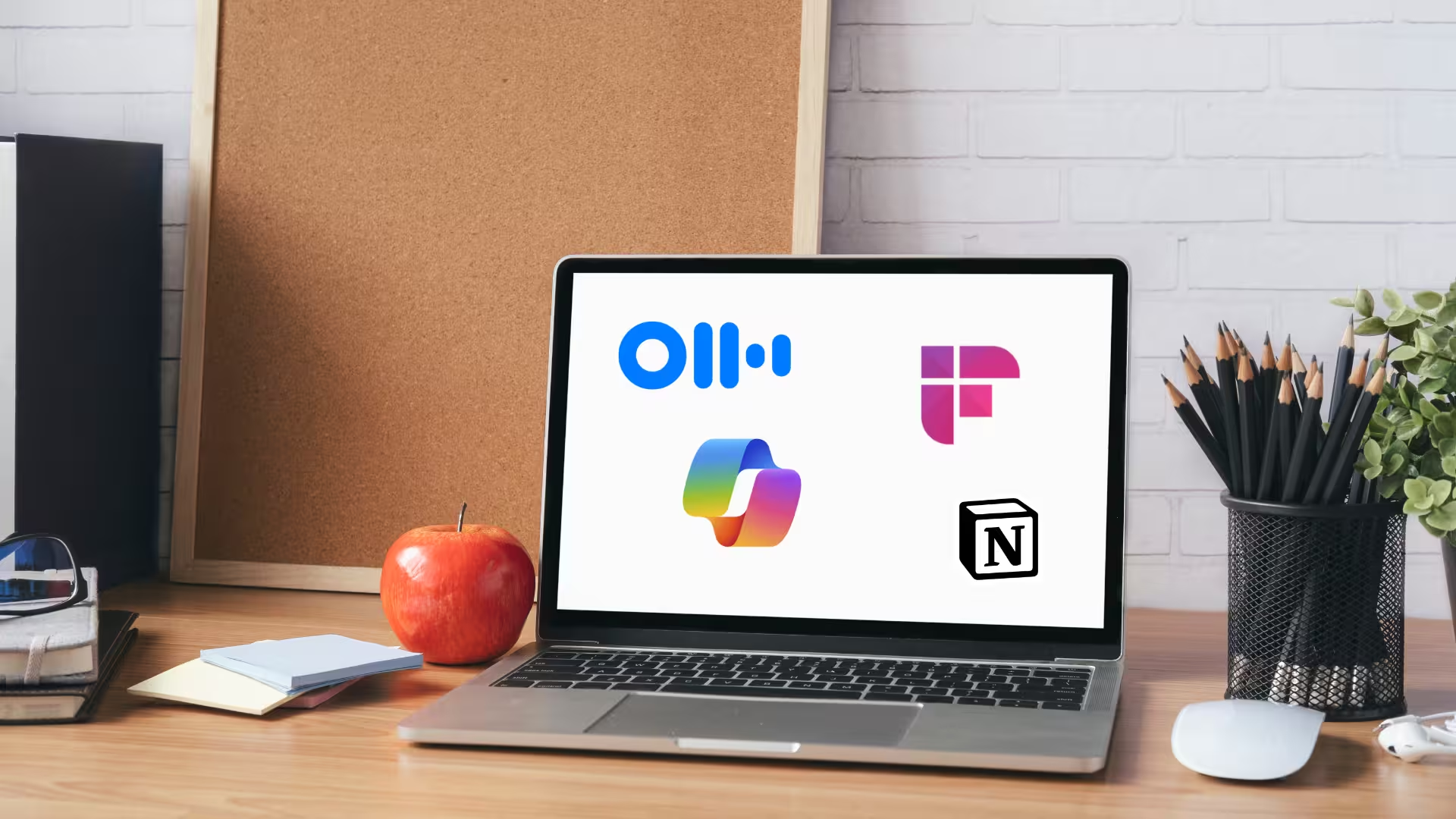
Otter.ai, Fireflies.ai, Notion AI, Microsoft Copilot – the best-known AI meeting assistants come from the United States. They are often mature, well-marketed, and convincing at first glance. But they share a structural problem that no feature update can fix: their data ends up – directly or indirectly – within the American legal sphere. And that sphere plays by different rules than the European one.
This article explains why server location is not a technical footnote when it comes to meeting tools, but a core legal decision. And why "EU region hosting" alone is not enough to put you on truly safe ground.
tl;dr: The Most Important Points at a Glance
- Server location ≠ data protection: Even data stored on EU servers can be subject to US law if the provider has a US parent company.
- CLOUD Act: US authorities can compel US companies to hand over data – even when it is stored in Europe.
- Schrems II & DPF: The EU-US Data Privacy Framework exists, but remains legally fragile. An appeal is still pending.
- What really counts: Hosting location, support access, key management, and corporate structure – all four factors together determine your actual level of data protection.
- The safe choice: A provider with its registered office, infrastructure, and operations entirely within the EU.
Why This Topic Is More Relevant Than Ever
Not long ago, the question of server location was mainly a concern for compliance teams at large corporations and public authorities. Today it arises for every organization considering an AI-powered meeting tool – and there are a great many of them.
The reason is simple: AI meeting assistants don't process harmless metadata. They listen. They transcribe strategy discussions, customer negotiations, HR meetings, product roadmaps. The resulting transcripts and summaries are highly concentrated information objects – searchable, exportable, and potentially stored indefinitely. If this data ends up in the wrong legal jurisdiction, the consequences are more serious than in almost any other SaaS category.
At the same time, the market for AI meeting tools is heavily US-dominated. Anyone searching for a solution today will encounter Otter.ai, Fireflies.ai, Avoma, Grain, or Microsoft Copilot for Teams first. All of them originate in the United States – and all of them are therefore subject to a legal framework that is in structural conflict with the GDPR.
What the CLOUD Act Really Means
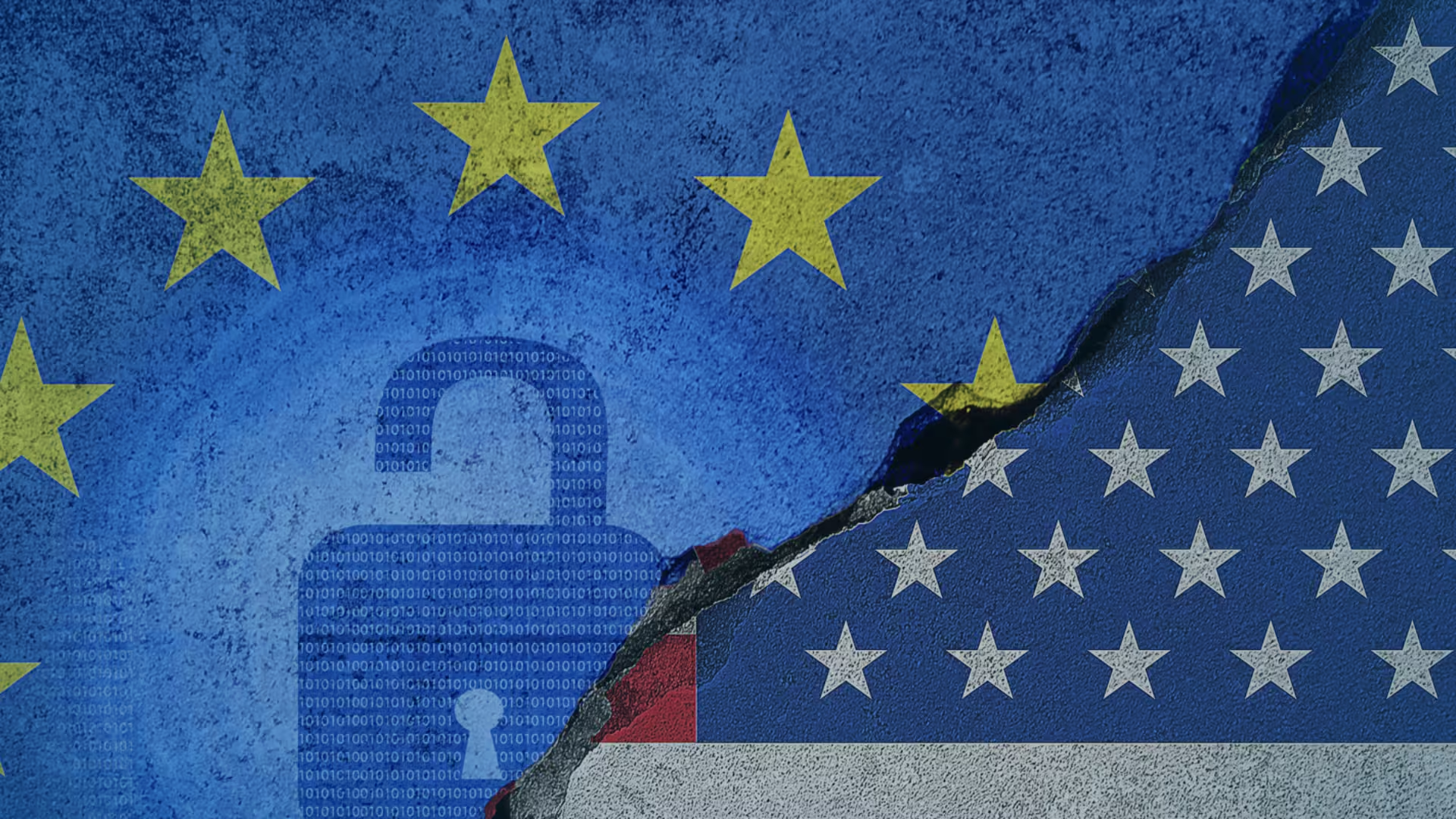
The Clarifying Lawful Overseas Use of Data Act, or CLOUD Act, was passed in the United States in 2018. It allows US law enforcement authorities to compel US companies to produce data – regardless of where that data is physically stored.
In concrete terms: a US-based meeting tool that stores your meeting recordings on a server in Frankfurt can still be compelled by US authorities to hand over that data. The server location does not protect you in this scenario.
The European Data Protection Board (EDPB), in a joint assessment with the EDPS, highlighted that the CLOUD Act can bypass traditional MLAT channels – the mutual legal assistance treaties that are supposed to ensure law enforcement cooperation between different countries proceeds in a coordinated and controlled way. The CLOUD Act enables a more direct route.
What this means for you:
- Data on EU servers belonging to a US company is not automatically protected from US government access
- Legal control follows the company – and that is determined by the law to which it is subject
- A US parent company extends CLOUD Act exposure to all subsidiaries, including European ones
Schrems II and the History of Failed Data Protection
To understand where we stand today, a brief look back is helpful.
2000–2015: Safe Harbor
The Safe Harbor agreement enabled data transfers between the EU and the US based on self-certification by US companies. It was considered sufficient – until Austrian data protection activist Max Schrems filed a complaint against Facebook and the European Court of Justice invalidated the agreement in 2015. The reason: US surveillance practices did not provide adequate protection for European fundamental rights.
2016–2020: Privacy Shield
Its successor, the EU-US Privacy Shield, was introduced as a more robust framework – until Schrems filed another complaint and the ECJ struck down the Privacy Shield in 2020 in the Schrems II ruling. Same reasoning: US mass surveillance programs such as PRISM, XKeyscore, and MUSCULAR were incompatible with European fundamental rights.
2023–present: EU-US Data Privacy Framework
In response to Schrems II, the European Commission adopted the EU-US Data Privacy Framework (DPF) in 2023 as a new adequacy decision. The DPF includes improved redress mechanisms for European data subjects and formal limitations on US intelligence activities.
In 2025, the DPF survived an initial legal challenge before the EU General Court. However, an appeal has been filed – meaning the prospect of Schrems III has not gone away. And even without a formal invalidation, the structural problem persists: US surveillance law conflicts with European data protection rights for as long as FISA Section 702 and Executive Order 14086 remain the foundation.
What does this mean for your tool choice? The DPF is usable – but it is not a stable foundation for a long-term procurement decision. Relying exclusively on the DPF means building your compliance strategy on a foundation that has already been pulled away twice before.
The Misonception: "EU Region Hosting" Is Not the Same as EU Data Protection (The 4 Factors That Matter)
Many US providers advertise "data in the EU" or "EU region servers." That sounds reassuring – but it only goes so far. Server location is just one of four factors that determine which legal system your data is actually subject to.
Factor 1: Where is data stored?
This is the question most people ask. An EU data center is a good start – but it is only a start.
Factor 2: Who has support access – and from where?
If support staff in the United States or other third countries can access production data, a data transfer is taking place – even if the data is physically located in Frankfurt. That transfer requires a legal basis, and it is subject to the access possibilities of the relevant state.
Factor 3: Who holds the encryption keys?
If the provider holds the keys and is required to hand them over to a US authority, EU hosting offers little protection. Customer-Managed Keys (CMK) – where you control the keys yourself – are the only technical safeguard that also holds up in a CLOUD Act scenario.
Factor 4: What corporate structure is the provider subject to?
A European subsidiary of a US corporation remains exposed to the CLOUD Act if the parent company is subject to US law and has access to its systems. Only a provider with no US corporate ties is structurally free from this exposure.
The honest question you need to ask: Can this provider demonstrate to me – technically, organizationally, and legally – that no US jurisdiction can access my meeting data?
What the Major US Providers Are Actually Subject To
Without making sweeping judgments about individual providers, it is worth looking at the structural characteristics of the best-known US-based meeting tools:
Otter.ai: Founded in the US, infrastructure primarily on US cloud services. No EU-specific hosting offering for standard customers. Data processing is subject to US law. GDPR-compliant use requires Standard Contractual Clauses (SCCs) – which, however, can be structurally undermined by the CLOUD Act.
Fireflies.ai: Also US-based, processing on US infrastructure. Fireflies processes not only audio but also meeting metadata and calendar content – a particularly broad data collection footprint. A robust EU data protection concept for the DACH market is absent.
Microsoft Copilot for Teams: Microsoft offers EU Data Boundary options – but as a US company, Microsoft is subject to the CLOUD Act. The EU Data Boundary approach is a meaningful step, but it is not complete protection as long as legal control remains with a US company. Additionally, deploying Copilot requires specific Microsoft 365 licenses and triggers its own data protection review.
Notion AI: Notion is primarily a document and collaboration tool with AI extensions. Meeting summaries are integrated into Notion's infrastructure – US-based, without an independent EU hosting concept for meeting data.
What these providers have in common: They are well-built, widely used, and genuinely useful for many applications. But for European organizations that process sensitive meeting content and take GDPR compliance seriously, they share a structural deficit that cannot be bridged.
What Standard Contractual Clauses Can and Cannot Do
When no adequacy decision applies – or when the DPF is once again invalidated – Standard Contractual Clauses (SCCs) are the most widely used transfer instrument. They are recognized by the EDPB and legally sound – but they have one critical limitation:
SCCs govern the relationship between the data exporter and importer. But they cannot override the law of a third country. If US authorities request access to data under the CLOUD Act or FISA Section 702, SCCs alone do not help.
The EDPB has therefore made clear in its recommendations on supplementary measures that SCCs for transfers to the US must be accompanied by additional technical and organizational measures – for example, strong end-to-end encryption with customer-controlled keys.
In practice, this means: anyone who wants to use a US provider while genuinely pursuing GDPR compliance must invest significant effort – and accept a residual risk that cannot be fully eliminated through structural means.
What "Hosted in Germany" Really Means – and When It's Enough
A provider that combines the following characteristics offers genuine structural data protection:
- Registered office in the EU (ideally Germany)
- Infrastructure exclusively with EU-based cloud providers or proprietary hardware in EU data centers
- Support access exclusively by EU-based personnel
- No US parent company and no US ownership structure that creates CLOUD Act exposure
- Clearly documented sub-processors – all with registered offices and processing locations in the EU
- Customer-Managed Keys as an option for the highest security requirements
For the majority of European organizations processing sensitive meeting content, this is the only configuration where the level of data protection does not depend on political developments in Washington.
The Industries Where This Is Particularly Critical
For some industries, server location requirements are not just a compliance consideration – they are a hard prerequisite:
Financial services
With DORA (Digital Operational Resilience Act) in force since January 2025, financial institutions must scrutinize their ICT third-party providers far more rigorously. This includes evidence of resilience, audit rights, and concentration risk analysis. A US-based meeting tool provider without a robust EU data protection concept will be very difficult to justify in BaFin-regulated environments.
Healthcare
Health data is among the most sensitive categories under Art. 9 GDPR. Medical confidentiality obligations and § 203 StGB protect patient information under criminal law. A meeting tool that potentially transcribes patient conversations and stores them on US infrastructure is simply not deployable in this context.
Legal services
Attorney-client privilege (§ 43a BRAO) provides absolute protection for client information. Law firms that record client conversations with a US-based AI tool risk professional conduct violations – regardless of how well the tool performs otherwise.
Public administration
German public authorities and institutions typically operate under BSI IT-Grundschutz standards and apply the BSI C5 catalogue as a benchmark for cloud services. US-based providers without the corresponding certifications are often ineligible for public tenders from the outset.
Companies with a works council
While not a sector-specific issue in the narrow sense: works councils in German companies regularly reject US-based monitoring solutions – and an AI meeting tool is, from a works council perspective, a potential monitoring system. A provider with German server infrastructure and a transparent data protection architecture makes the works agreement process considerably easier.
The Questions You Should Ask Your Current or Future Provider
Whether you are evaluating a new meeting tool or re-evaluating an existing provider, these questions form your framework for assessing server location:
- Where exactly are recordings, transcripts, summaries, and backups stored?
- Which sub-processors are involved in the processing – and where are they located?
- From which locations can support staff access production data?
- Is the company or a parent company subject to US law?
- On what legal basis do data transfers to third countries take place?
- What is your contingency plan if the EU-US Data Privacy Framework is restricted or invalidated?
- What is your policy on government requests – and do you commit to challenging them, minimizing disclosure, and notifying us wherever legally possible?
- Are Customer-Managed Keys available?
A provider that gives clear, written answers to these questions has thought through its data protection approach. Anyone who deflects, defers, or points to "EU region hosting" without addressing the other factors either hasn't fully understood the structural risks – or doesn't want to make them transparent.
Conclusion: Server Location Is a Leadership Decision
The decision to adopt an AI meeting tool should not be made on the basis of feature lists and price comparisons alone. Server location, corporate structure, and legal control over your data are factors that carry more weight in the long run than any individual product feature.
The good news: European alternatives to the US market leaders do exist – tools that don't force a compromise between functionality and data protection. The only question is whether you have them on your radar.
Why Sally Is the European Answer
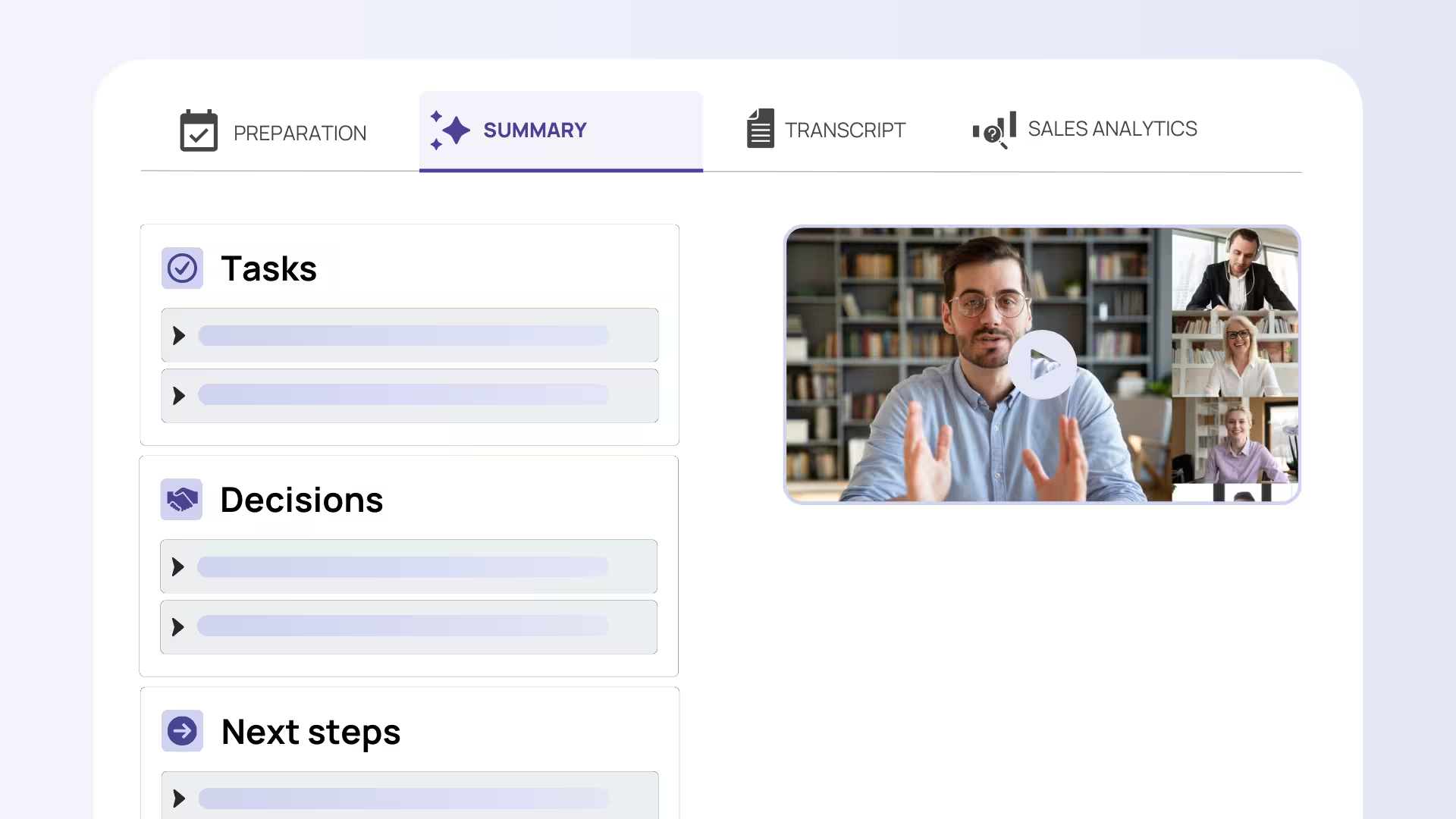
Sally was built in Germany in cooperation with a large German corporation. Since day 0, we believe that genuine AI-powered meeting intelligence and genuine data protection are not a contradiction:
- ✓ Registered office and infrastructure in Germany – no US corporate background, no CLOUD Act exposure
- ✓ All data stays in the EU – recordings, transcripts, summaries, backups
- ✓ Full sub-processor transparency – all service providers with EU registered offices
- ✓ DPA included, automatic consent notification, configurable deletion periods
- ✓ No use of customer data for AI training
- ✓ SOC 2 in preparation | ISO 27001 in preparation | BSI alignment
You know Otter.ai, Fireflies, or Microsoft Copilot – and you're looking for an alternative that delivers the same intelligence without conflicting with your data protection strategy? That's exactly what Sally is built for.
PS: You can try Sally for free!


