

Why Meeting KPIs Make Sense
Meetings are expensive—not just because people invest their time, but because they often lead to the most important decisions, priorities and next steps. That’s exactly why it’s worth moving beyond gut feelings when evaluating meetings.
KPIs turn instinct into measurable improvements. They reveal which meetings create real value, which ones just fill up calendars, and where small tweaks can lead to big results. If you’re a manager, business owner, or part of HR or sales, meeting KPIs are a powerful lever to boost team productivity, speed, and clarity.
One thing to keep in mind: Meeting KPIs aren’t about control. The goal isn’t to monitor people—it’s to design meetings that drive faster decisions, ensure follow-through, and protect focus time.
What Are Meeting KPIs and Why Do They Matter?
Meeting KPIs are metrics that make the quality, efficiency and impact of your meetings measurable. They help you answer three key questions with data:
- Are our meetings well prepared and run efficiently?
- Are the right people involved and actively contributing?
- Do we end up with valuable outcomes that get implemented?
If you can consistently answer these questions, optimizing your meetings becomes straightforward. You’ll start to spot patterns, set clear standards, and improve your meeting culture step by step.

The Most Important Meeting KPIs
Below, you’ll find proven meeting KPIs that work in practice. You can use them individually or combine them into a small KPI set. We strongly recommend using a set (more on that later).
Attendance Rate
What it measures: How relevant a meeting is to those invited.
Why it matters: If many people are invited but few show up, something is off—wrong audience, unclear agenda, too many mandatory meetings or bad timing. A stable, high rate signals good prioritization.
Formula: Attendance Rate = (Number of Attendees / Number of Invitees) × 100
Pro Tip: High attendance is key for mandatory meetings (e.g. weekly leadership syncs). For optional formats (like open Q&As), a lower rate is fine as long as the value is clear.
Start and End Punctuality
What it measures: Whether meetings start and end on time.
Why it matters: Punctuality multiplies productivity. A meeting that starts 5 minutes late wastes much more time when multiplied by the number of attendees.
Formulas:
- Start Punctuality = (Meetings that start on time / Total Meetings) × 100
- End Punctuality = (Meetings that end on time / Total Meetings) × 100
Pro Tip: Define a clear rule: "Start means start." Use default durations like 25 or 50 minutes instead of 30 or 60 to allow buffer time.
Planned vs. Actual Time
What it measures: The deviation between scheduled and actual meeting time.
Why it matters: Frequent overruns often point to poor agendas, weak moderation or the wrong attendees. Consistently short meetings may indicate overloaded agendas or misaligned topics.
Formula (percentage deviation): Time Deviation = ((Actual Time – Planned Time) / Planned Time) × 100
Pro Tip: Focus on outliers—meetings that regularly overrun by 20–40%—not just the average.
Agenda Usage
What it measures: How often meetings have a clear agenda.
Why it matters: An agenda is the bare minimum of preparation. Without one, meetings tend to be talk-heavy with few decisions.
Formula: Agenda Usage = (Meetings with an Agenda / Total Meetings) × 100
Pro Tip: Agendas don’t need to be long. Two to five points are enough if the outcome is clear.
Meetings Without an Agenda
What it measures: The number of meetings held without a predefined agenda.
Why it matters: Reducing agenda-less meetings typically leads to less wasted time.
Formula: Meetings Without an Agenda = Number of such meetings per week or month
Pro Tip: Set a simple standard: No meeting without an agenda unless it’s an urgent incident.
Meeting Size
What it measures: Number of participants per meeting.
Why it matters: Larger meetings are costlier and harder to manage. The more people, the less likely a real discussion happens.
Formula: Meeting Size = Number of Attendees
Pro Tip: If no clear decisions or tasks emerge, the group may be too large or misaligned.
Participation Rate
What it measures: How many attendees actively contribute.
Why it matters: High engagement improves decision quality and buy-in. Low participation often signals dominance, irrelevance or discomfort.
Example Formula: Participation Rate = (Number of Active Contributors / Total Attendees) × 100
Pro Tip: Especially in HR or leadership meetings, engagement is more important than speed. Even in sales, avoid one-person monologues.
Speaking Time Balance
What it measures: How evenly speaking time is distributed.
Why it matters: Uneven speaking time isn’t always bad (e.g. trainings), but in decision-focused meetings, dominance often stifles discussion.
Formula: Speaking Share = Individual Speaking Time / Total Speaking Time
Pro Tip: Watch for recurring patterns—who always dominates, who never speaks, and in which meeting types.
Action Items per Meeting
What it measures: Number of concrete tasks resulting from a meeting.
Why it matters: Meetings without outcomes often lack tasks or decisions. Action items signal that discussions are turning into action.
Formula: Action Items per Meeting = Number of Action Items / Number of Meetings
Pro Tip: More isn’t always better. Aim for 3–5 clear tasks in major meetings.
Action Item Completion Rate
What it measures: How many tasks actually get done.
Why it matters: One of the most powerful KPIs. Many organizations don’t have too many meetings, they have too little follow-through.
Formula: Completion Rate = (Completed Action Items / Total Action Items) × 100
Pro Tip: Assign clear owners and deadlines—otherwise, high completion is unlikely.
Decision Rate
What it measures: How many meetings lead to documented decisions.
Why it matters: Especially relevant in management, HR and sales. If meetings avoid decisions, work is delayed.
Example Formula: Decision Rate = (Meetings with Documented Decisions / Total Meetings) × 100
Pro Tip: Not every meeting needs a decision, but each should clearly state its intent: decision-making or information-sharing.
Meeting Investment Cost
What it measures: The financial cost of a meeting.
Why it matters: 30 minutes with 10 people isn’t the same as 30 minutes with 3. Knowing the cost helps set priorities.
Simple Formula: Meeting Cost = Sum (Hourly Rate per Person × Meeting Duration in Hours)
Monthly Salary Tip: Hourly Rate ≈ Monthly Salary / (Work Hours per Month)
Pro Tip: Use this KPI to plan smarter, not to label people "too expensive."
Meeting Delay Cost
What it measures: The cost of starting late.
Why it matters: Delays waste time and disrupt focus. They affect mood and the following meetings.
Formula: Delay Cost = Sum (Hourly Rate per Person × Delay Time in Hours)
Pro Tip: This KPI is often a wake-up call—it visualizes an otherwise invisible issue.
Meeting Feedback Score
What it measures: Participant satisfaction.
Why it matters: Duration and punctuality don’t tell the full story. A short, on-time meeting can still be pointless. Quick feedback fills that gap.
Example Logic: Feedback Score = Average Rating (e.g. 1 to 5)
Alternative: Ask, "Was this meeting helpful?" (Yes or No)
Pro Tip: Keep it short and simple, or people won’t stick with it.
Meeting ROI
What it measures: Value relative to effort.
Why it matters: Forces a fundamental question: Was the meeting worth it? Especially important for leaders.
Simple Formula: Meeting ROI = (Estimated Outcome Value – Meeting Cost) / Meeting Cost
Pro Tip: You don’t need to calculate exact values. A rough estimate—high, medium, or low value—is often enough.
Challenges When Measuring and Analyzing Meetings
Meeting KPIs are powerful, but there are common pitfalls. Recognizing them early helps you avoid them.
KPIs Are Seen as Control Tools
If employees feel KPIs are used for monitoring, acceptance will drop fast. The goal should be clear: to improve meetings for everyone. From the start, clarify what data is collected, why it’s used, and who can access it.
Focus on team-level or meeting-type-level analysis, not individuals. Collaborate on improvements—this builds fairness and trust.
Too Many Metrics, Too Little Impact
Some teams build a "KPI graveyard". Start with a small set—5 to 7 KPIs that align with your goals. Ideally, they cover preparation, execution and results, so you measure both hygiene and impact.
Assign each KPI a clear owner and a regular review routine. Otherwise, you’ll end up with numbers that don’t lead to change.

Lack of Context
A KPI without context can easily lead to false conclusions. For instance, low participation might be fine if the meeting is an info session. That’s why it’s essential to differentiate by meeting type—1:1s, weeklies, project meetings, sales calls, hiring sessions, client meetings. This allows you to define meaningful target values and make fair comparisons.
Poor Data Quality and Tool Silos
When calendars, video tools, task managers, and documentation are disconnected, you end up with manual work and inconsistent data. KPIs become unreliable and time-consuming. Missing data, inconsistent attendee lists, or inaccurate start times are common. Clean integration and a clear single source of truth are critical to keeping KPIs reliable and scalable.
Goodhart's Law
According to Goodhart's Law, a metric loses its value when it becomes a target. For example, if a call center KPI is "number of calls completed," agents might cut calls short to hit the number. The same goes for meeting KPIs: if "fewer meetings" is the goal, you get overloaded mega-meetings. If it's "more action items," you may get meaningless tasks. That’s why KPIs should always be viewed as a set and evaluated holistically.
Data Privacy and Trust
Analyzing meetings, especially content, requires clear rules: who can see what, how long data is stored, and how consent is managed. Without these foundations, even the best analytics can become politically sensitive.
Automated Tracking with Sally AI: Making Meeting KPIs Easy
Manual tracking is the main reason meeting KPIs vanish after a couple of weeks. That’s exactly where Sally AI comes in.
Sally joins your meetings, creates a transcript, and generates structured notes. From this, KPIs are automatically derived—no one has to take minutes or manually collect data.
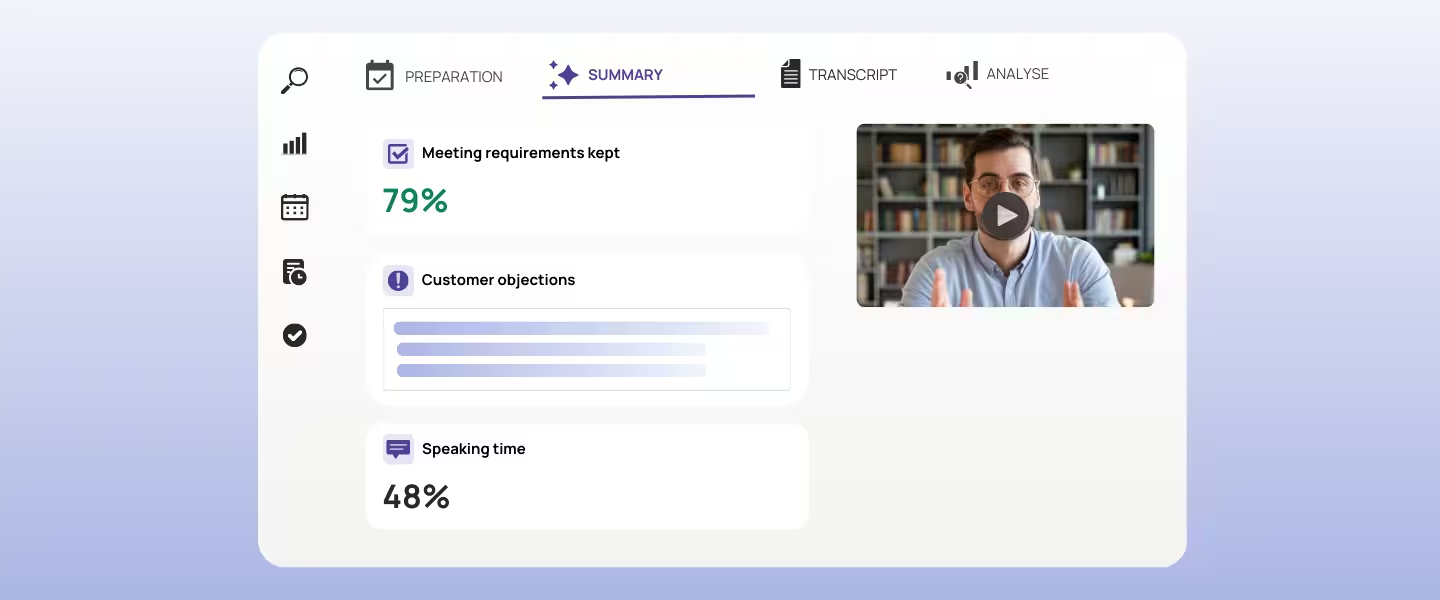
Automatic Meeting Metadata from Calendar and Video Tools
Sally can use meeting data from invites and tools to automatically track key KPIs:
- Frequency and number of meetings per week or month
- Meeting duration and planned vs. actual time
- Number of participants and attendance rate
- Start and end times as a basis for punctuality
This forms the foundation of meeting hygiene and works especially well for companies feeling overwhelmed by too many meetings.
Automatic Outcomes from Transcripts and Summaries
The biggest impact comes from what’s actually said in meetings.
Sally can identify and structure:
- Decisions
- Action items (including assignees and deadlines, if mentioned)
- Next steps
- Key topics and highlights
This makes KPIs like Decision Rate and Action Items per Meeting nearly automatic.
Analytics on Participation and Communication Dynamics
Sally can analyze speaking time and show you how discussions are distributed. This is especially helpful for:
- Participation Rate
- Speaking time per person
- Trends over time (e.g. by team or meeting type)
This gives HR and leadership valuable insights into whether meetings are truly collaborative—or if silent expertise is being overlooked.
Follow-Through via Integrations
Meeting KPIs only make an impact if they translate into daily workflows. Sally can push tasks and outcomes directly into your existing tools.
Examples include:
- Tasks into project management tools
- Notes into documentation tools
- Sales insights and follow-ups into your CRM
This makes the Action Item Completion Rate much more realistic, since tasks don’t vanish in meeting notes—they show up where work actually happens.
Our Recommendation: How to Implement Meeting KPIs
When introducing meeting KPIs, start small and stay consistent. From our experience, a simple approach works best:
Start with a Clear Goal
Do you want to save time, make better decisions, boost execution, or improve collaboration? Your goal defines your KPI set.
Use a Lean KPI Set
Most teams do well with a core set like:
- Planned vs. Actual Time
- Punctuality
- Agenda Usage
- Decision Rate
- Action Item Completion Rate
- Feedback Score
Separate Meeting Types
Don’t compare apples and oranges. A sales call is not the same as a team weekly. When you segment your meeting types, your KPIs become much more meaningful.
Automate as Much as Possible
Only automated tracking is sustainable. With Sally AI, you get the data foundation you need—without adding to your team’s workload. At the same time, outcomes are immediately usable, since decisions, tasks and next steps are structured and integrated into your tools.
When you treat meetings as a system instead of a necessary evil, you gain time, focus and momentum. Meeting KPIs are a practical starting point—and with Sally, everyday tracking becomes finally realistic.


